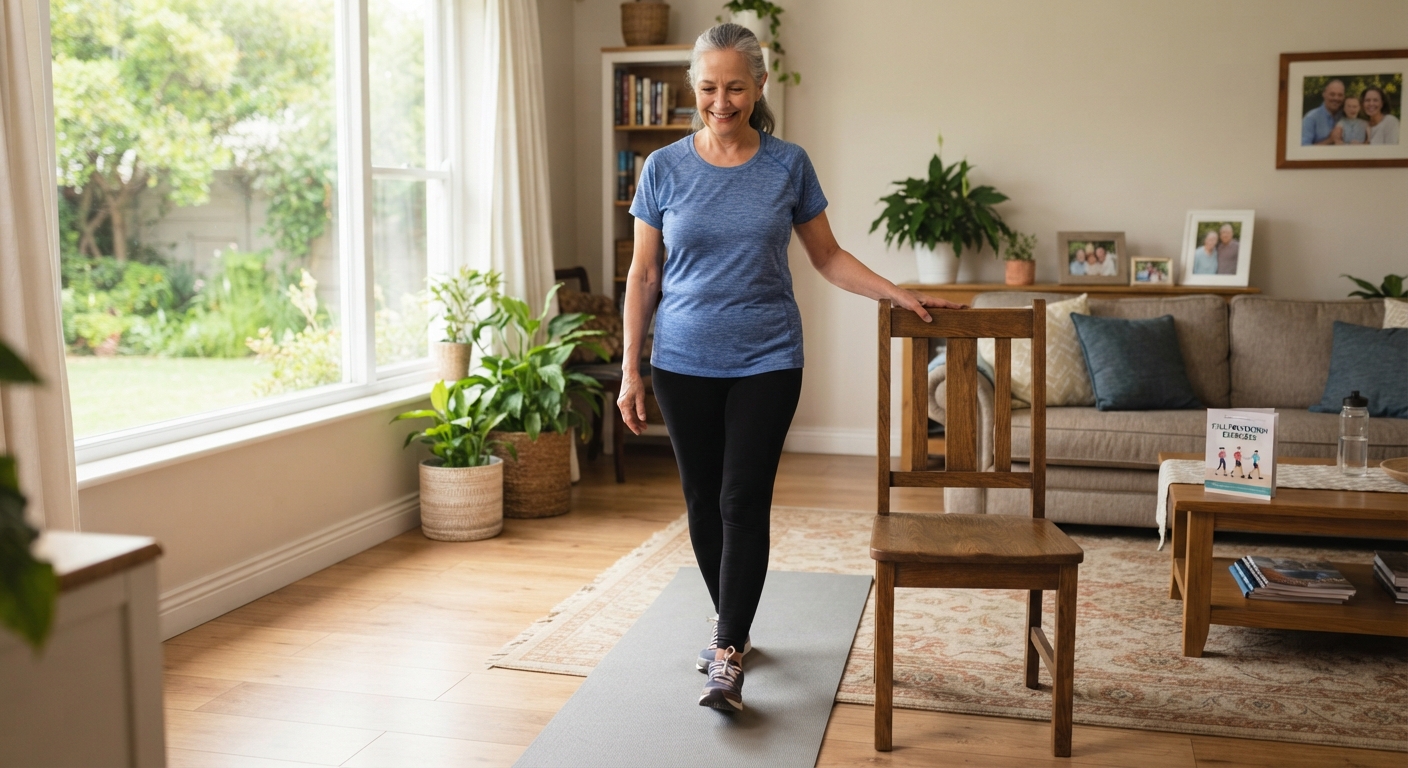
The Game Plan:
A simple fall prevention and balance exercise program can become part of a daily routine. From my perspective, the safest approach is to begin at a level that matches your age and ability, then gradually work toward becoming stronger and improving balance. Strength exercises, controlled movements, proprioception, coordination, and balance skills all have an important place in managing fall risk.
As we age, falls can have serious consequences, especially for older adults. The goal is not to let fear change how you enjoy living your best life. Instead, regular movement can help older adults maintain strength, protect muscle mass, stay independent and active, and reduce the chances of experiencing falls.
An expert home caregiver can also help older adults perform exercises safely in-home, while caregivers and children with aging parents can encourage an older loved one to stay proactive during their senior years. Staying strong and maintaining good balance may help lower the risk of falling or tripping, while reducing the impact that an accident could have on an older person’s daily life.
10 Approved Fall Prevention Exercises for Seniors
For fall prevention exercises seniors can use at home, the main goal is to build strength training, improve balance, and make everyday movements feel safer. Physical therapists often adapt these exercises to different fitness levels, so seniors can begin slowly and stay within a comfortable range. If you notice pain or have existing injuries, stop and speak with your medical team before continuing. From a practical perspective, having a stable surface nearby makes these movements easier to perform with confidence.
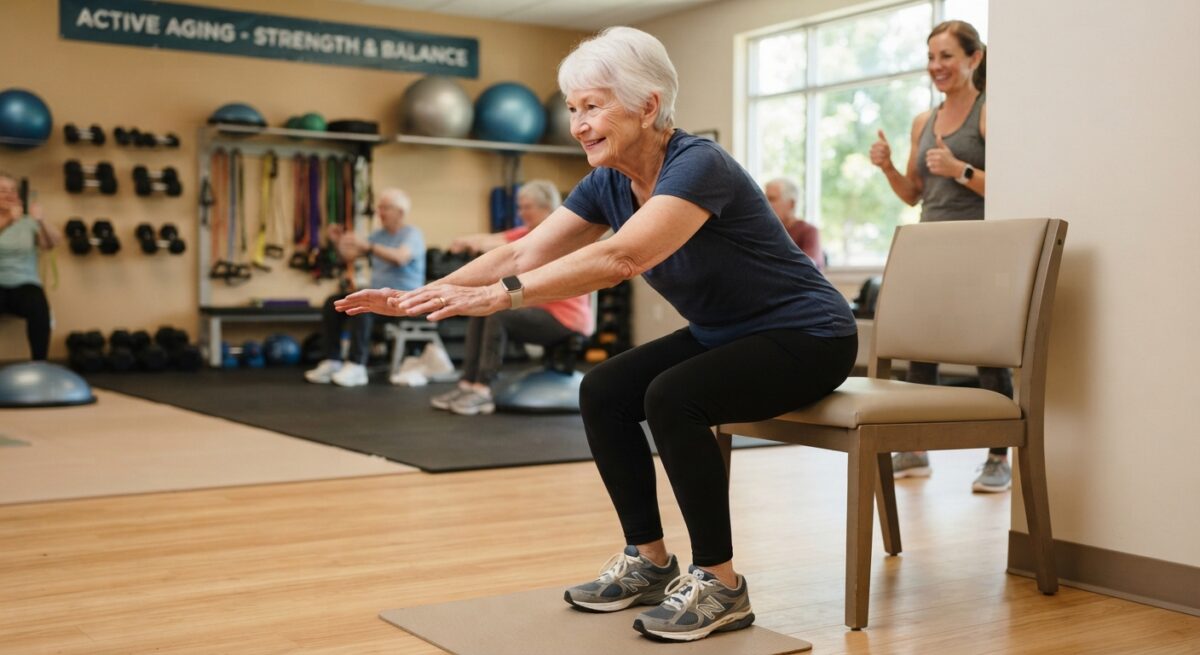
Sit to Stand
The sit to stand is a simple fall prevention movement that works the leg muscles while practicing controlled standing. It can be especially useful for someone with weaker balance, because a chair, countertop, or high table can provide extra support when you feel unsteady. Keep the movement controlled rather than rushing through it.
How to do it:
- Place a sturdy chair near a countertop or other stable surface.
- Sit at the front of the seat with your legs uncrossed and feet flat on the floor.
- Keep your hands on the chair at first if you need help controlling your body weight.
- Bend forward, bringing your chest toward your toes.
- Squeeze your glutes and slowly rise into a standing position.
- As your balance improves, work toward standing without using your hands.
- Repeat 10 times, twice a day, as long as the movement remains comfortable.
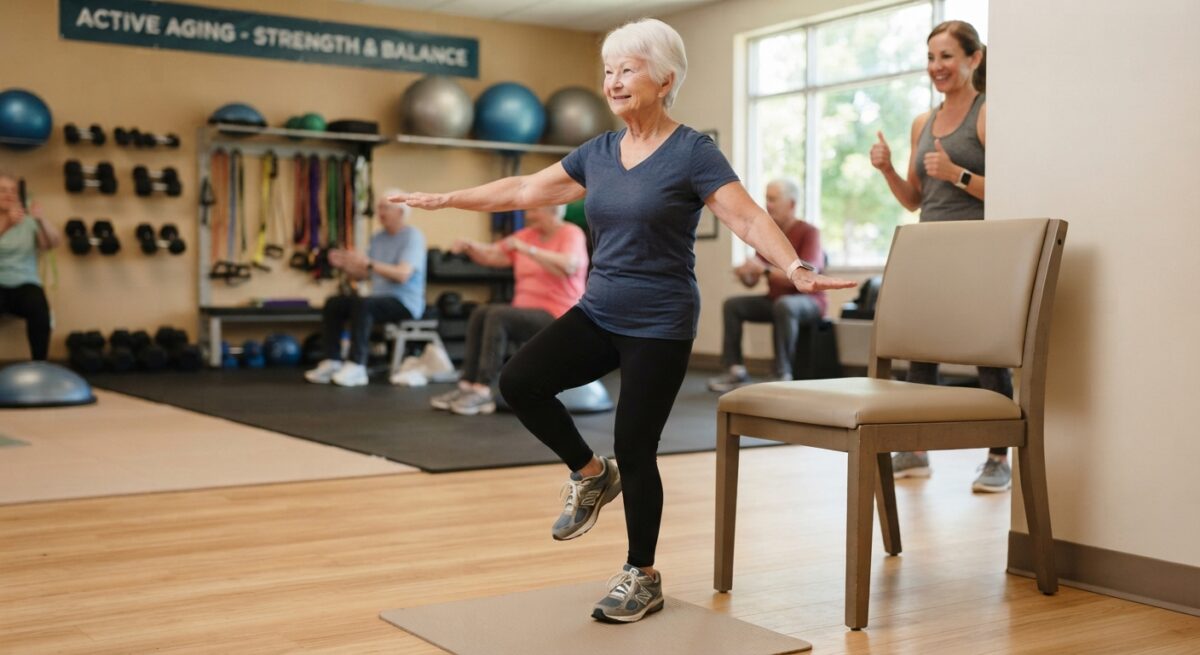
Single-Leg Stance
The single-leg stance is a physical therapist-recommended movement that challenges balance while using one leg at a time. Because it places more demand on the body, use a sturdy chair for support. The exercise is gentle on the joints, but it should always be performed in a safe area.
How to do it:
- Stand behind a sturdy chair and place both hands on the back of a chair.
- Keep your knees slightly relaxed rather than locked.
- Lift your right leg from the floor.
- Hold the position for five seconds.
- Return the leg to the starting position.
- Repeat the movement five times, then use the other foot.
- With practice, gradually increase the amount of time your raised leg stays off the floor.
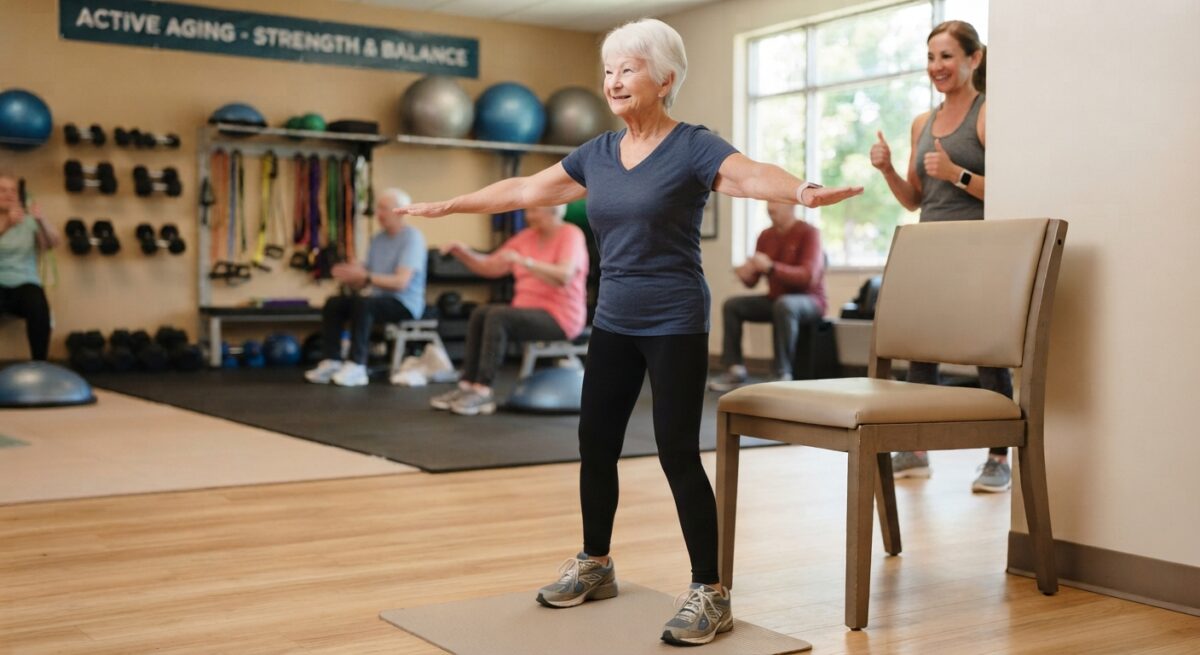
Feet Apart Balance
Standing with the feet apart gives seniors an easy way to practice steady posture before moving to more challenging balance work. This position uses a shoulder-width apart stance and can be done with eyes open. If you notice swaying, a wall or counter can provide minimal support while you learn to hold the position firmly.
How to do it:
- Stand with your feet apart, approximately shoulder-width apart.
- Keep your eyes open and look ahead.
- Stand steady for 10 seconds.
- Gradually work your way up to 30 seconds.
- If you notice swaying, lightly touch a wall or counter for support.
- Continue practicing until you can hold the position with minimal support.
One-Foot Balance
The one foot exercise takes the previous balance challenge a step further. It teaches the body to control weight on one side while the other leg is lifted. Start with your eyes open, and use a stable surface if necessary.
How to do it:
- Stand upright with your eyes open.
- Slowly shift your weight onto one leg.
- Lift the opposite foot from the floor and hold the position.
- Begin with 10 seconds.
- Gradually work toward 30 seconds.
- Lower the foot safely and switch to the other foot.
- Keep a chair, counter, or wall nearby if you need support.
Eyes-Closed Balance
Once the first three exercises feel easy and you can perform them safely with little support, closing your eyes can provide an additional challenge. This should only be attempted when you already have good control, because removing visual information makes balancing harder.
How to do it:
- Choose a safe location with a sturdy support nearby.
- Perform the balance position you have already practiced.
- Once stable, close your eyes carefully.
- Hold for 10 seconds, gradually working up to 30 seconds.
- Stop immediately if you feel unsafe, lose control, or need more support.
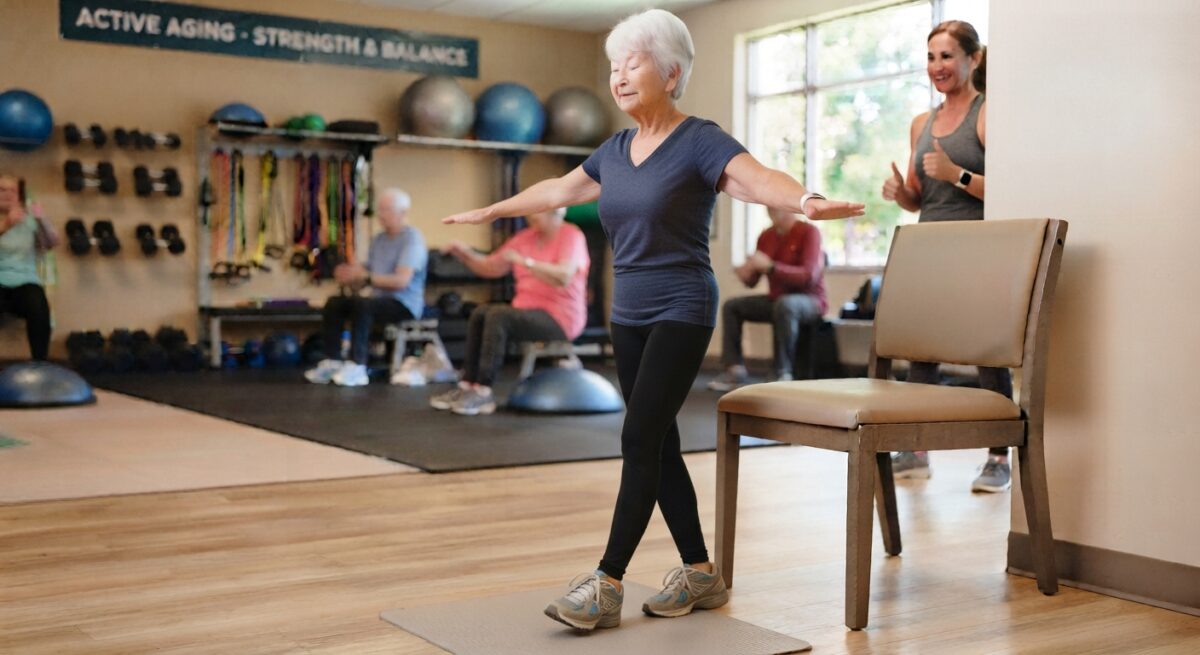
Heel-to-Toe Walk
The heel-to-toe walk is a fall-prevention exercise that trains balance while you are moving. It encourages control of your center of gravity and requires careful foot placement. Before starting, wear loose clothing, comfortable clothing, and supportive shoes. A strip of tape on the floor can create a straight line to follow.
How to do it:
- Place a strip of tape on the floor in a straight line.
- Stand at one end while wearing supportive shoes and comfortable clothing.
- Place the heel of your left foot directly in front of the toes of your right foot.
- Make sure the heel is touching or almost touching the toes of the opposite foot.
- Step forward with your right foot, placing it in front of your left.
- Step forward with your left foot, returning to the opposite position.
- Continue using the opposite foot for 20 steps.
- Turn around and repeat the exercise five times, using support if needed.
Heel Raise
The heel raise strengthens the calf muscles and thigh muscles while supporting overall balance and flexibility. It can help older adults prevent falls, and a kitchen counter or the back of a sturdy chair can provide additional balance. This is a useful exercise when you want to work on controlled movement without walking.
How to do it:
- Stand behind a sturdy chair with your feet flat and shoulder-width apart.
- Keep a slight bend in your knees.
- Hold the chair lightly for balance.
- Slowly lift your heels from the floor using the balls of your feet.
- Pause briefly at the top.
- Lower your heels back down to the starting position.
- Complete two sets of 10–15 repetitions.
- If you need support, perform the movement near a kitchen counter or chair rather than exercising without a stable surface.
March in Place
The march in place exercise combines core stability, balance, and standing control. This physical therapist-approved exercise can help older adults prevent falls by improving one-leg movements and developing leg strength that may reduce shuffling during daily movement. A wall or countertop can provide extra support when needed.
How to do it:
- Stand with your feet slightly apart.
- Keep your arms at your side.
- Hold a wall or countertop lightly if you need extra support.
- Lift your right knee toward your chest while keeping your left leg straight.
- Lower the right leg back toward the floor.
- Repeat with your left knee while the right leg supports you.
- Continue to march in place, alternating the right and left knee for up to 30 seconds.
- Repeat five times, focusing on controlled one-leg movements rather than speed.
Sideways Walking and Controlled Leg Reach
Sideways walking is a simple fall-prevention exercise that trains the legs to step sideways while improving stability. A narrow stance makes the balance challenge greater, while a resistance band and deeper squat can make the exercise more demanding. A separate controlled leg reach can also train the core, hips, and standing leg.
How to do it:
- Stand with your feet hip-width apart and keep a slight bend in your knees.
- Move into a mild squat position.
- Slowly take a step to the right with your right foot.
- Bring your left foot beside your right foot.
- Take another step to the right and complete 10 steps.
- Change direction and repeat for another 10 steps toward the left.
- For a controlled leg reach, stand arm’s length away from a sturdy surface.
- Lightly place one hand on the surface for support and put the other hand on your hip.
- Shift your weight onto one leg with a slight bend in that knee.
- Brace your core and hinge forward from your hips.
- Extend your free leg behind you while your torso lowers.
- Keep your back flat and hips facing toward the floor.
- Move slowly and maintain control and stability.
- Press through the foot of your standing leg to return to the starting position.
- Continue for 8 to 12 repetitions on each side, depending on your ability.
Weight Shifting and Standing Marches
Weight shifting can help build confidence with everyday activities such as walking and climbing steps. If you feel apprehensive about your balance, stand near sturdy furniture or ask a caregiver for extra security. Standing marches can be added to build strength, flexibility, and coordination between the upper body and lower body, while also improving hip flexor strength and core strength for practical movements.
How to do it:
- Stand with your feet hip-width apart.
- Slowly shift your weight from your left foot to your right foot with control.
- Continue shifting between both sides for 30 seconds.
- Keep a sturdy surface or caregiver nearby if you need extra security.
- For standing marches, lift one knee until your thigh is as close to parallel to the floor as possible.
- Keep your torso straight throughout the movement.
- Slowly return your foot flat to the floor.
- Alternate legs while maintaining control.
- Perform 20 reps.
- This movement can support functionality for walking, going up and down stairs, stepping onto higher surfaces, and rising from sitting in a chair.
Fall Prevention Exercises for Seniors Routine
For seniors, the easiest way to integrate fall prevention exercises safely is to keep the routine simple and repeatable. I usually recommend that people start small, build habits gradually, and focus on consistency rather than intensity.
| Day | Activity | Suggested routine |
| Monday | Exercises | Strength, balance, and flexibility exercises |
| Tuesday | Walk | 10-30 minutes at a comfortable pace |
| Wednesday | Exercises | Short 10-minute sessions, building gradually |
| Thursday | Walk | Walking or another moderate activity |
| Friday | Exercises | Strength, balance, and flexibility |
| Saturday | Walk | A relaxed walk; increase time gradually |
| Sunday | Rest or gentle movement | Keep the body moving without forcing intensity |
Summary
Falls are not inevitable with aging. For seniors, the right exercises can build strength and confidence, helping them stay on their feet, remain independent, and feel safer at home. Regular, safe movement and consistent movement can help someone who is fearful of walking across a room regain confidence in daily activities.
From a practical care perspective, starting early can help reduce the risk of falling, while a healthcare professional can provide personalized guidance for a loved one.
As people get older, physical abilities may decline, including a gradual loss of muscle strength, muscle mass, and function, making it harder to stay steady and maintain balance. Regular exercise, especially lower body strengthening and core workouts, can support mobility, stability, and fall prevention. If an older parent has difficulty with sitting, standing, walking, or other daily activities, assisted living may be worth considering.
A reputable, professional senior living community can provide daily care, fall prevention exercises, and senior-focused extracurriculars that support physical health, social health, and emotional health, while promoting prevention and long-term independence.
FAQ’s
What is the best exercise to prevent falls in seniors?
For elderly people and seniors, a single-leg stand and Tai Chi are useful options because they improve balance control and work the stabilizing muscles that help you stay upright. Experts generally recommend a balanced routine that includes balance training, leg strengthening, and flexibility, rather than relying on one exercise alone.
What are 10 simple exercises that can help prevent falls?
Ten simple exercises can help build strength and improve stability. Examples include sit-to-stands, single-leg stands, and heel-to-toe walks, along with other balance, strength, and flexibility activities. Making these exercises part of a regular routine can support fall prevention.
How can seniors learn to fall safely?
Seniors can practice relaxation and learn techniques for protecting the head if a fall happens. When possible, aiming to land on cushioned muscle rather than hard bone may reduce the impact. Learning safe responses should be practiced carefully, preferably with guidance from a qualified professional.
What are simple ways to prevent falls?
Stay physically active, remove home hazards, and wear supportive footwear. These simple habits can work alongside exercises that improve balance, strength, and flexibility. Regular movement and a safer home environment can make everyday activities more manageable.
What is a useful fall prevention device for seniors?
A fall prevention device can provide extra support alongside exercise and home safety measures. Medical Guardian is one example of a medical alert and fall detection system for seniors, with features such as GPS tracking, accuracy, and a user-friendly setup. Device features and suitability can vary, so compare options based on the individual’s needs.