The Game Plan:
Calf stretches are a simple way to care for your calf muscles, especially after inactivity, repetitive strain, or a strenuous leg workout. I’ve found that when the intensity of a training plan suddenly increases, the calves can become tight, tense up, and develop sore calf muscles.
Gentle stretching can release tight calf muscles, reduce tightness, and ease soreness and pain. Since these muscles extend from the back of the knee into the lower leg, learning to effectively stretch them can also improve function.
What are your calf muscles?
Your calf muscles include the gastrocnemius, which forms most of the bulk of the lower leg, and the soleus, which sits underneath it. Both connect near the knee and heel, while a smaller plantaris runs between them; the Cleveland Clinic notes that about 10% of people have only the gastrocnemius and soleus. In fitness and kinesiology, these muscles are known for plantar flexion, helping you point your toes, stand up on tiptoes, and press a gas pedal.
From my experience with basic movement and exercise, calf strength also matters for explosive power, including sprinting and jumping, and supports strength training during lower-body compound exercises such as the squat and deadlift.
12 Calf Stretches Exercises
Downward Dog
- Start in a high plank with your hands under your shoulders. Spread your fingers and press your palms firmly into the floor.
- Push your weight backward and lift your butt toward the ceiling until your body forms an inverted V shape.
- Keep your heels moving gently toward the floor while keeping your knees slightly soft if needed.
- You should feel a comfortable calf stretch through the lower calf. This classic yoga pose can also lengthen the hamstrings, lower back, and glutes.
- Hold the position while maintaining slow, steady breathing.
Pro and safe tip: Do not force your heels to the floor. Keeping the knees slightly bent can make it easier to maintain good form. If you feel sharp pain instead of normal stretching tension, stop.
Downward Dog With Foot Pedal
- Begin in a high plank with your hands below your shoulders. Keep your fingers spread and your palms firmly on the floor.
- Lift your hips toward the ceiling and form an inverted V shape.
- Keep your upper body steady and press the toes of one foot into the floor.
- Slowly lower the heel of the opposite foot toward the floor.
- Switch sides and repeat the same action with the other foot.
- Continue this gentle pedaling motion, creating controlled foot movement and a moving calf stretch.
Pro and safe tip: Move slowly instead of bouncing. The goal is to explore comfortable ankle movement, not force the heel down. Keep your weight controlled through your hands and feet throughout the exercise.
Seated Calf Stretch With a Resistance Band
- Sit on the floor with your legs extended in front of you.
- Place a resistance band around the front of one foot.
- Hold both ends of the band with your hands.
- Keep the leg relaxed and gently pull the band toward you so your toes move toward your body.
- You should feel a gentle stretch through the calf and along the shin.
- Slowly release the tension and repeat on the opposite side.
Pro and safe tip: Use light or moderate resistance rather than pulling hard. The band should guide the foot, not force it into an extreme position. Keep your breathing relaxed throughout the movement.
Single-Leg Heel Drop Stretch
- Stand with the balls of the feet on the edge of a step and hold a secure surface if needed.
- Shift your body weight onto one leg.
- Slowly allow the heel of that leg to move below the step while the front of your foot remains supported.
- Return the heel to the starting position using a controlled up and down movement.
- You can use a gentle pedaling action when alternating between sides.
- Repeat with the other leg.
Pro and safe tip: Treat this as a dynamic stretch, not a sudden drop. Keep the movement slow and controlled. If the stretch becomes painful, reduce the range of motion or stop.
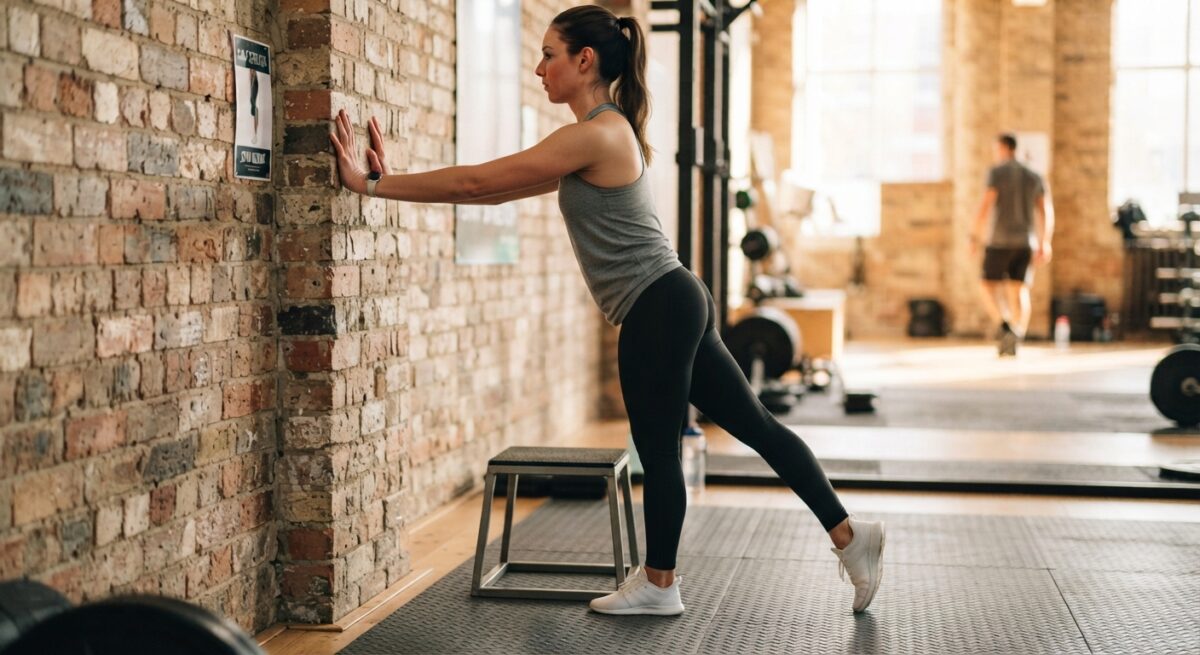
With a wall
- Stand about an arm’s length from a wall.
- Place your arms and hands against the wall for support.
- Put your right leg forward and your left leg behind to create a front leg and back leg.
- Keep the back heel on the floor.
- Keep the back leg relatively straight and allow the front leg to become a bent leg.
- Gently lean toward the wall until you feel a stretch.
- Hold for 15–20 seconds.
- Perform three sets, then change to the opposite leg.
Pro and safe tip: Keep the back foot pointing forward and avoid lifting the back heel. You can gently straighten the back leg, but do not lock the knee. Keep the movement comfortable rather than forcing a deeper stretch.
Without a wall
- Use a standing calf stretch by placing your right leg behind the other leg.
- Keep the front leg slightly bent and the back heel firmly on the floor.
- Shift your body weight forward slowly until you feel the calf stretch.
- Hold for 15–20 seconds.
- Complete three sets before switching to the opposite leg.
Pro and safe tip: Since there is no wall for support, use a stable surface nearby if you need help with balance. Keep your body weight controlled and avoid leaning so far forward that your heel lifts.
Heel Cord Stretch With Bent Knee
- Stand facing a wall with your hands resting against it.
- Place your right leg behind you and your left leg in front.
- Keep both feet pointing generally forward.
- Bend the back knee while keeping the toes facing forward rather than turning them inward.
- Keep both heels connected with the ground.
- Move your hips gently toward the wall while maintaining a stable centered position.
- Keep your hip alignment comfortable and avoid letting one hip rotate excessively.
- Hold for 30 seconds.
- Complete three sets, then switch to the opposite leg.
Pro and safe tip: Keep your hips and feet aligned while leaning toward the wall. Avoid shifting your body to one side to create extra range. Your goal is controlled mobility, not maximum depth.
Towel Stretch
- Sit on the floor with your legs comfortably straight.
- Place a hand towel around the ball of the foot.
- Hold the towel at both ends with your hands.
- Keep your body upright with a straight back.
- Gently pull the towel toward you until you feel the calf stretch.
- Hold for 30 seconds, then relax.
- Repeat for three sets.
- Adjust the towel tension to control the stretch intensity.
Pro and safe tip: Avoid aggressive pulling on the towel. Keep your back in a straight posture and let the stretch intensity increase gradually. A controlled stretch duration is more useful than forcing a deeper position.
Calf Raises
- Stand behind a chair or near a stable tabletop that can provide support.
- Place your hands on the support and establish your balance.
- Keep your right foot stable while the left leg is positioned as needed for support.
- Shift onto the working right foot and keep the right knee comfortably aligned.
- Slowly raise the heel, then lower it with control.
- Perform 10 repetitions.
- Complete three sets, then switch to the opposite leg.
- You can later perform the exercise with a straight leg while maintaining control.
Pro and safe tip: Do not rush the raise and lower phases. Use the support to improve balance, not to pull yourself upward. Keep your body weight centered over the working foot.
Plantarflexion and Ankle Dorsiflexion
- Plantarflexion and ankle dorsiflexion train the ankle in opposite directions and can complement calf stretching.
- Sit or lie in a stable position and attach an elastic stretch band securely.
- Use comfortable resistance that allows controlled movement.
- Move the foot away from the body for plantarflexion, then bring it back toward the body for dorsiflexion.
- Keep the ankle controlled rather than allowing it to twist.
- These movements can support calf muscles strengthening and general lower leg control.
- Controlled ankle work can complement an overall injury prevention plan.
Pro and safe tip: Begin with low resistance and focus on the quality of each repetition. The goal is controlled ankle movement, not maximum force. If either the dorsiflexion stretch or plantarflexion stretch causes pain, reduce the range.
Dorsiflexion Stretch
- Sit on the floor with your legs straight.
- Attach an elastic band securely to a piece of stable furniture, such as a heavy chair or sturdy table.
- Place the band around your foot.
- Keep your toes pointing naturally as you establish your starting position.
- Gently move the foot toward your body to create the dorsiflexion stretch.
- Return slowly to the starting position.
- Perform 10 repetitions and then change to the opposite leg.
- Keep the ankle movement slow and controlled.
Pro and safe tip: Check that the furniture is stable before beginning. Never use an object that can slide or tip. Keep your body relaxed and avoid pulling so hard that the ankle moves beyond a comfortable range.
Plantar flexion Stretch
- Sit on the floor with your legs straight.
- Secure the elastic band around the front of your foot.
- Hold the band with your hands.
- Begin from a comfortable starting position with the ankle relaxed.
- Slowly guide the foot into plantarflexion, allowing the toes to move away from your body.
- Return to the starting position with control.
- Perform 10 repetitions, then repeat on the opposite leg.
- Keep the ankle movement smooth throughout each repetition.
Pro and safe tip: Do not use the band to force the foot through a large forward movement. Keep the resistance comfortable and maintain control from start to finish.
General Stretching Tips
- Use these calf stretching exercises as part of a wider stretching routine rather than relying on one exercise.
- For general flexibility, consistency is usually more useful than trying to stretch extremely hard once in a while.
- A short warm-up can help your body feel more prepared before deeper stretching exercises.
- If your calves feel stiff in the morning, begin with gentle movement before stronger stretches.
- A warm shower can help you feel more comfortable before mobility work, although it does not replace a proper warm-up.
- After a workout, allow your breathing and heart rate to settle before performing relaxed stretches.
- Daily stretching can be useful for some people, but intensity should vary according to your activity and recovery.
- For a simple routine, two to four times a week can provide regular practice without turning every session into an intense flexibility workout.
- Combine breathing techniques with slow movements. Relaxed breathing can help reduce unnecessary tension from the nervous system and discourage tensing up.
- Practices such as yoga can combine breathing, movement, flexibility, and body awareness in one session.
- Treat stretching as a gradual protective measure, not a guarantee against injury.
- During regular practice, pay attention to whether a sensation feels like normal muscle tension or concerning discomfort.
- If you experience persistent or sharp pain, stop the exercise and consider getting advice from an appropriate healthcare professional.
What Causes Tight Calves?
- Overuse and repetitive stress from running, cycling, or hiking can cause tight calf muscles, especially after increased training intensity or training frequency without proper exercise recovery.
- Inactivity, a sedentary lifestyle, or an inactive lifestyle can limit the normal range of motion, leading to muscle tightness and reduced flexibility.
- Poor footwear, unsuitable shoes, unsupportive running shoes, or high heels can change your form, restrict range of motion, and contribute to stiff calf muscles, muscle tension, and muscle imbalances.
- Muscle cramps may cause temporary pain, stiffness, and tightness, while dehydration, electrolyte imbalances, and certain medications can contribute to cramping. Stay hydrated, especially around demanding workouts.
- An injury, including calf muscle strains or Achilles tendonitis, can cause soreness, stiffness, and limited movement in an injured calf involving the Achilles tendon.
- Sitting at a desk for long periods can reduce walking and normal movement, leaving the knee joints and ankle joints in one position and reducing how often the calves move.
- Restricted movement through the foot, from the heel to the ball of the foot, can affect calf function and contribute to tightness when normal movement is repeatedly limited.
- The neuromuscular system and brain control how the muscles respond to movement. A reduced signal for a larger range may make the body more cautious about movement, while regular stretching can help muscles lengthen and contract through a greater range.
- Consistent exercise and regular stretching may improve muscle contraction and help reduce recurring cramping, stiffness, and tightness when combined with appropriate activity and recovery.
Summary
Simple calf stretches can help manage tight calf muscles, improve functional mobility, and support calf flexibility by increasing the range of motion in the knees and ankles. Adding these stretches to a regular fitness routine may help reduce tightness, pain, and the risk of injuries, especially when symptoms are linked to over activity or insufficient stretching.
However, persistent symptoms may be linked to underlying medical conditions, including nutrient imbalances, nutrient deficiencies, peripheral vascular disease, or deep vein thrombosis, so unexplained or severe pain should be medically assessed.
FAQ’s
Should I Stretch a Sore Calf Muscle?
If soreness comes from inactivity or overuse, gentle stretches may help reduce tension. If a sore calf muscle follows an injury, sprain, or strain, avoid stretching until you speak with a healthcare professional. They may suggest cold therapy, activity modification, or other treatments, especially if there is significant pain.
What Deficiency Causes Tight Calves?
Some tight calves may be linked to a deficiency of certain vitamins or minerals needed for normal muscle function. Important electrolytes include magnesium, potassium, sodium, and calcium, while vitamin D also supports muscle health. Losing electrolytes through sweat or not getting enough essential nutrients may contribute to muscle tension, cramping, or weakness.
Is Walking Good for Tight Calves?
Yes, walking at a casual pace can gently work your leg muscles and improve blood flow. A short walk can also act as a warm up before a calf stretching routine and may reduce muscle tension. Taking walking breaks, staying active, or going for a stroll after eating can help keep your legs moving.
How Can I Stretch My Calves Myself?
You can stretch your calf muscles at home with a simple Standing Wall Calf Stretch. Use a wall for support, keep the rear heel down, and move gently into the stretch. This method can be performed safely and effectively when you avoid forcing the range or stretching into pain.