The Game Plan:
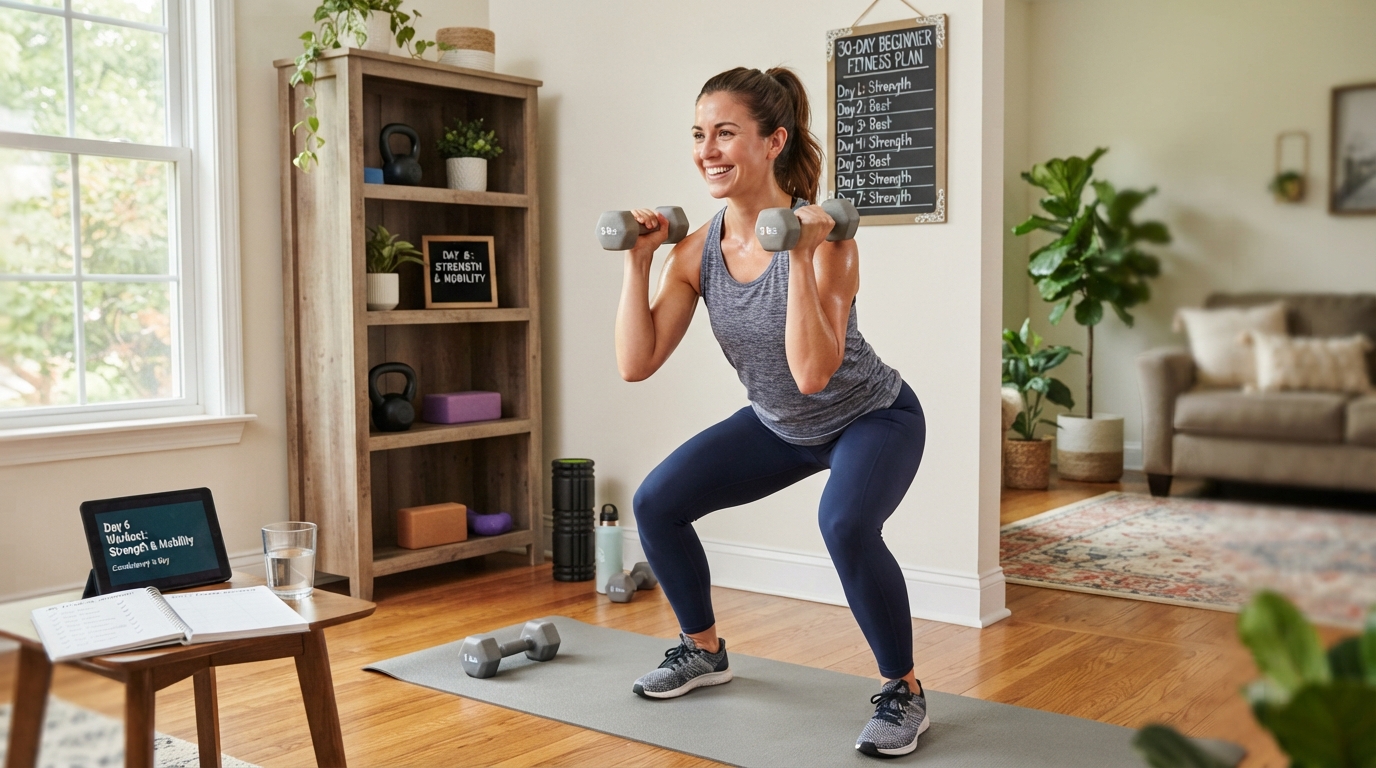
This 30-Day Beginner Fitness Workout Plan is an at-home built around strength, functional fitness, fat loss, and mobility. Its strength workouts and mobility-focused workouts create a structured schedule while keeping the flexible schedule suitable for a changing fitness journey. Whether you are starting for the first time or restarting after a break, the goal is to harness energy, get started, and develop consistency through manageable physical activity.
Starting an exercise routine for 30 days can feel exciting, especially when motivation comes from wanting to make a real change. Research from the European Journal of Social Psychology suggests that forming a new habit takes an average of 66 days, which makes the first 30 days an important starting point for consistent exercise. For beginners, the biggest barriers are often uncertainty and doing too much too quickly.
A simple workout using zero equipment can help the body adapt without feeling overwhelmed, while increasing difficulty progressively. From my experience with beginner-friendly fitness, the best exercise program is one you can actually follow through with, rather than one that leaves you exhausted after the first week. By day 30, steady effort can help you feel stronger, more flexible, and build confidence in your fitness habit.
How This Plan Works
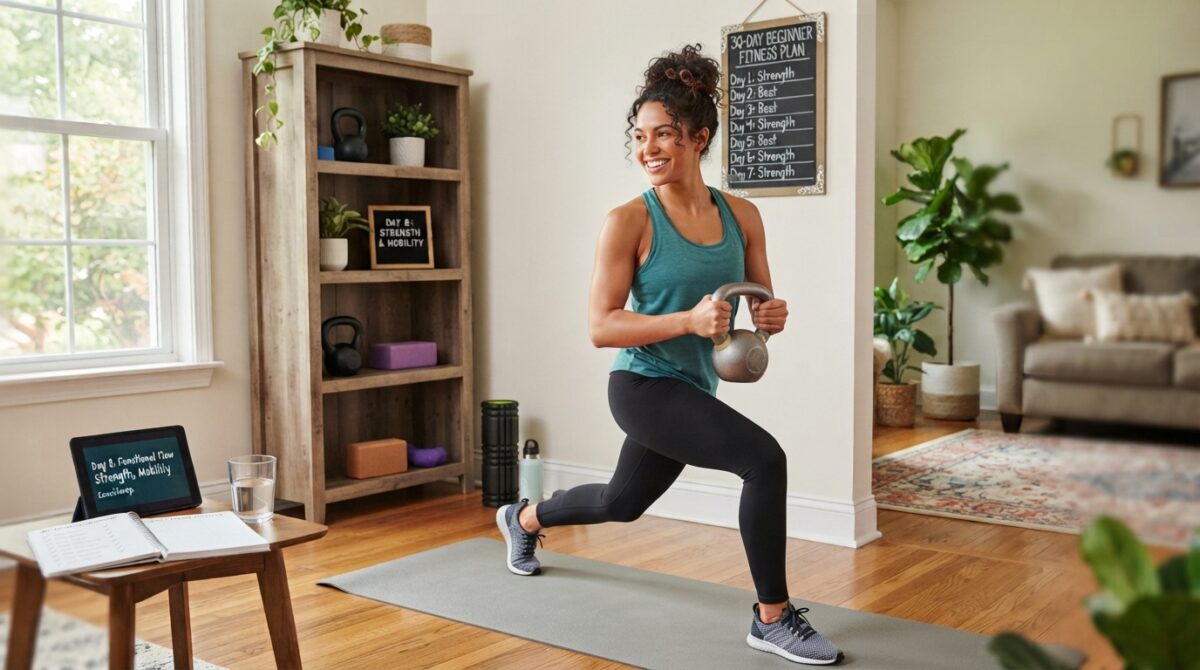
The 4 workout days per week are Monday, Wednesday, Friday, Saturday, leaving 3 rest days for active recovery days or full rest. The workout structure becomes slightly more demanding with each week, using more reps, longer holds, and challenging exercise variations instead of moving from easy to hard overnight. This gradual progression is intentional because beginners need enough recovery to adapt.
A good weekly progression should challenge you without making every session feel like a test. If the goal is to build muscle, a muscle-building phase can include resistance training for 3-4 days per week, with a rest day or active recovery day between demanding sessions. From my experience, using heavier weights later on with controlled reps and enough recovery time gives the muscles room to grow stronger and supports muscle growth without rushing the process.
Week 1 Plan
The foundation of Week 1 is learning the movements and reaching the goal of using proper form rather than chasing speed or difficulty. I recommend treating this first week as practice: focus on moving correctly, breathing steadily, and becoming comfortable with each fundamental movement. The circuit below uses 2 rounds, with 30 sec for each exercise and 15 sec rest between movements.
| Part | Week 1 Plan | Details |
| Foundation (Learning the Movements) | Bodyweight Squats → Wall Push-ups → Reverse Lunges → Plank Hold → Glute Bridges → Marching in Place | 2 rounds, 30 sec each exercise, 15 sec rest |
| Bodyweight Squats | Squat with controlled movement | Focus on proper form |
| Wall Push-ups | Push against a wall | If too easy, use incline push-ups on a counter |
| Reverse Lunges | Alternate legs | Keep the movement controlled and alternating |
| Plank Hold | Hold a plank | Starting from the knees is OK; if planks feel tough, hold as long as you can and rest for the remainder |
| Glute Bridges | Controlled bridge movement | Keep the focus on the fundamental movement |
| Marching in Place | March steadily in place | Choose an accessible variation |
| Warm-up | 5 minutes | Warm up at an easy pace (PE: 4) |
| Rest set | 3 minutes | Increase speed and resistance/incline to a moderate level (PE: 5) |
| Work set | 1 minute | Increase incline and resistance by 1 percent to 5 percent to raise the intensity level (PE: 7) |
| Rest set | 3 minutes | Return to PE: 5 |
| Work set | 1 minute | PE: 7 |
| Rest set | 3 minutes | PE: 5 |
| Cooldown | 5 minutes | Finish with a cooldown at PE: 4 |
The first week uses the most accessible variations so your body can learn the pattern before you add more challenge. If wall push-ups feel too easy, move to incline push-ups using a counter. If the plank hold is tough, simply hold it for as long as you can, then rest for the remainder of the time. For the cardio portion, the 5 minutes of warm up starts at an easy pace, followed by each 3 minutes rest set and 1 minute work set. Adjust speed, resistance, and incline gradually rather than forcing the intensity level too high. This approach keeps Week 1 manageable while building confidence with each exercise.
Week 2 Plan
Week 2 focuses on building endurance with the goal of keeping the same exercises but making them slightly harder. Instead of making a big jump, add a few reps, extend holds, or reduce rest. I prefer this kind of gradual progress because these small changes keep beginners challenged without pushing them too far outside their comfort zone.
| Day | Week 2 Workout | Details |
| Day 1 | 25-minute cardio session | 25 minutes of cardio |
| Day 2 | Basic strength training | Each exercise: 2 sets of 15 reps, 20 to 30 seconds resting between sets |
| Day 3 | Beginner intervals level 2 | Interval training, progressing toward 25 minutes |
| Day 4 | Basic yoga | Yoga with controlled movement and recovery |
| Day 5 | Basic strength training | Each exercise: 2 sets of 15 reps, 20 to 30 seconds resting between sets |
| Day 6 | 25-minute cardio session | 25 minutes of cardio |
Week 3 Plan
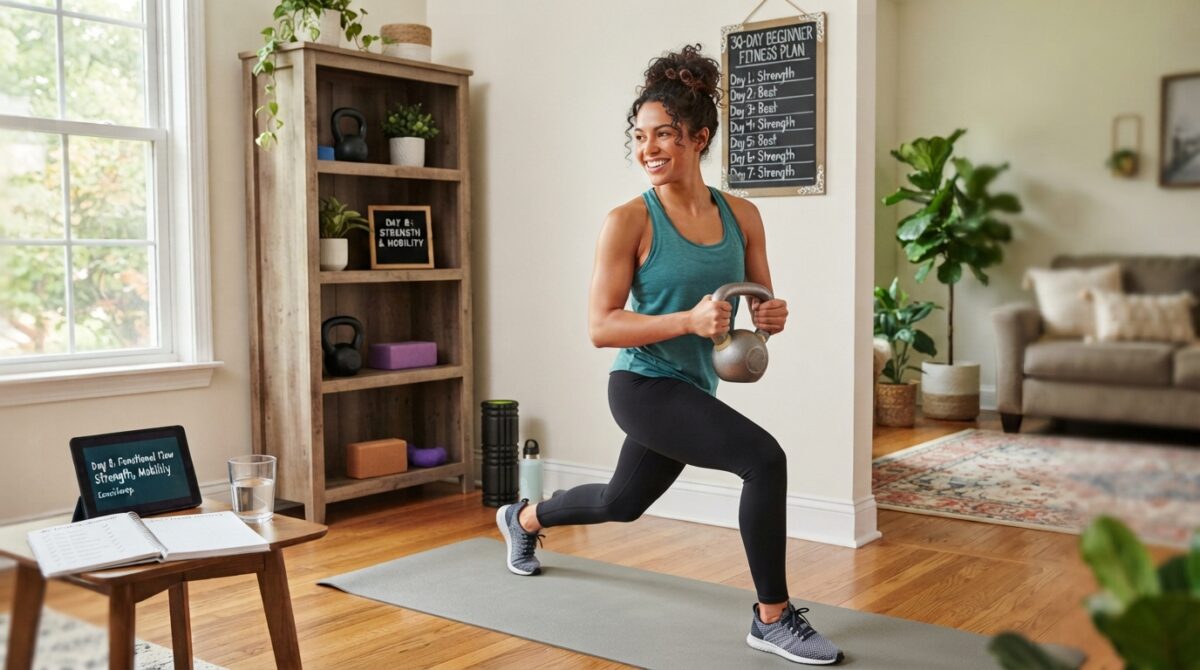
Week 3 is about adding challenges without turning the beginner workouts into an all-out test. The goal is to use harder variations and increase intensity while still keeping control. I find this kind of steady progression more useful than making sudden drastic changes, because it lets you handle a greater workload while keeping good form.
| Day | Week 3 Plan | Details |
| Day 1 | 30-minute cardio session | Cardio workouts now reach 30 minutes |
| Day 2 | Beginner total-body strength level 2 | Each exercise: 1 set of 15 reps |
| Day 3 | Beginner intervals level 3 | Interval workout with higher levels of intensity |
| Day 4 | Yoga on the ball | Yoga using an exercise ball for support and challenge |
| Day 5 | Beginner total-body strength level 2 | Each exercise: 1 set of 15 reps |
| Day 6 | 30-minute cardio session | Cardio workouts at 30 minutes |
Week 4 Plan
Week 4 is about Putting It All Together. The goal is to handle full-effort workouts using advanced-beginner variations without losing good form. From my experience, this is where progressive overload starts to feel real: movements that seemed difficult in Week 1 can now become manageable because your body has gradually adapted.
| Day | Week 4 Plan | Details |
| Day 1 | 30-minute cardio session | Cardio for 30 minutes |
| Day 2 | Beginner total-body strength level 2 | Each exercise: 2 sets of 15 reps, resting 20 to 30 seconds between sets |
| Day 3 | Interval workout level 3 | Intervals at the planned intensity |
| Day 4 | Yoga on the ball | Yoga using an exercise ball |
| Day 5 | Beginner total-body strength level 2 | Each exercise: 2 sets of 15 reps, resting 20 to 30 seconds between sets |
| Day 6 | 30-minute cardio session | Cardio for 30 minutes |
What to Expect From Each Week
- Week 1: During the first 2 sessions, some soreness is normal and usually fades as your body adjusts. You may need to focus on breathing during exercises, and feeling uncoordinated with new movements is completely expected. I usually tell beginners not to judge their progress by how smooth the first few workouts feel.
- Week 2: Soreness decreases significantly, and movements start feeling more natural. You may notice improved energy levels on workout days, while the warm-up begins to feel easy. These small changes are useful signs that your body is responding to regular exercise.
- Week 3: Look for visible strength improvements. Exercises that once felt hard in Week 1 may now feel manageable, while sleep quality often improves. You may also start looking forward to your workouts instead of dreading them, which shows that exercise is becoming easier to accept as part of your routine.
- Week 4: You may notice a clear difference in your body—you can feel more toned, stronger, and have more energy. The 20-minute sessions can begin to feel like your time, rather than another task. You are exercising because you want to, not because you feel you should, which is a strong sign that the habit is taking hold.
- Day 30: Think of Day 30 as a checkpoint, not a finish line. The purpose of the challenge is to build a routine that can survive beyond 30 days. If you have been showing up three or four times a week for a month, you have already completed the hard part and your habit is forming.
- After 30 days: Keep the same weekly rhythm and start adding simple goals. You may want to build more strength, join a group class, or simply continue what is working; consistency matters more than making an extreme change. As Summer approaches, you can walk into it feeling strong, energized, and in control of your routine because you gave yourself 30 days and allowed consistency to do its job.
FAQ’s
What is a good 30-day workout plan for beginners?
A good 30-day beginner plan usually trains 3-4 days per week with progressive difficulty. Start with foundational bodyweight exercises such as squats, push-up modifications, lunges, planks, and glute bridges at a manageable intensity, then increase reps, add harder variations, and use reduced rest periods. Structured multi-week beginner programs with instructor guidance can also help.
Can you see measurable results in 30 days of working out?
Yes. Measurable results can appear within 30 days. Strength improvements may show in 2-3 weeks, while body composition changes often begin around week 3-4; more visible changes can take 6-8 weeks. Energy levels, sleep quality, and mood improvements may appear during the first 7-10 days. Consistent training can also improve muscular endurance, cardiovascular fitness, and functional strength.
How long should a beginner work out each day?
Twenty minutes is a practical beginner workout length because it can provide a meaningful training effect while remaining sustainable. Include a warm-up, main workout, and cooldown. After 4-6 weeks, you can gradually increase sessions to 25-30 minutes. The American College of Sports Medicine recommends 150 minutes of moderate activity each week, which can be supported by four 20-minute sessions plus walking on rest days.
Can I lose 5kg in 30 days?
Losing 5kg (11 pounds) in 30 days is possible for some people, but it is an aggressive target. It may require a daily calorie deficit of about 580 to 600 calories and strong lifestyle consistency. A safer approach is to focus on sustainable nutrition, regular fitness activity, and gradual progress rather than forcing rapid weight loss.
Can beginners safely do a 30-day challenge?
Yes, a 30-day challenge can work well for beginners when it stays low-intensity, includes built-in rest days, and focuses on foundational movements. The key is to increase difficulty gradually and listen to your body. A sensible beginner challenge should build consistency without making every workout exhausting.