The Game Plan:
Recovery is not simply a break from a scheduled workout; recovery days are an important part of strength training, cardio sessions, and long-term fitness goals. In my experience, both fitness experts and everyday exercisers benefit from treating recovery with the same intentionality as their regular workouts. The science and research around training consistently point toward the value of giving the body time to recover, support muscle repair, and repair muscle tissue after a demanding training session.
A complete recovery day routine can include active recovery exercises, mobility work, and self-care practices rather than complete inactivity. For anyone who spends time at the gym or exercising at home, this approach can make it easier to manage muscle soreness, lower injury risk, and return ready for the next workout.
Going full-throttle every day may seem like the fastest route to better strength and endurance, but even seasoned athletes need rest. Active recovery workouts, gentle light movement, suitable rest day activities, proper nutrition, and simple habits that support recovery can help the body adapt, rebuild, and get stronger.
Rather than seeing rest days as lost training time, I see them as part of the training process itself: they give the body room to recover while supporting performance for the next challenge. This balance between recovery, movement, nutrition, and rest can help you train consistently without treating every day as a maximum-effort session.
Why Recovery Days Matter More Than You Think
If you skip recovery, your muscles may not fully repair the micro-tears caused by training, while your nervous system can remain in a stressed state. Elevated cortisol and higher cortisol levels can affect fat storage and muscle breakdown, while poor recovery may cause performance to reach plateaus or declines. The Journal of Strength and Conditioning Research has reported that athletes using structured recovery days can improve performance compared with those doing high intensity training every day.
The muscle-building process does not happen only during a workout; over 24–72 hours, your body repairs and strengthens the stressed tissue. Strength training can stress muscle fibers, while running and other cardio workouts challenge the cardiovascular system, and these high-level workouts can lead to muscle fatigue and soreness. In my experience, rest days give the body a valuable chance to respond to stress and rebuild before the next demanding session.
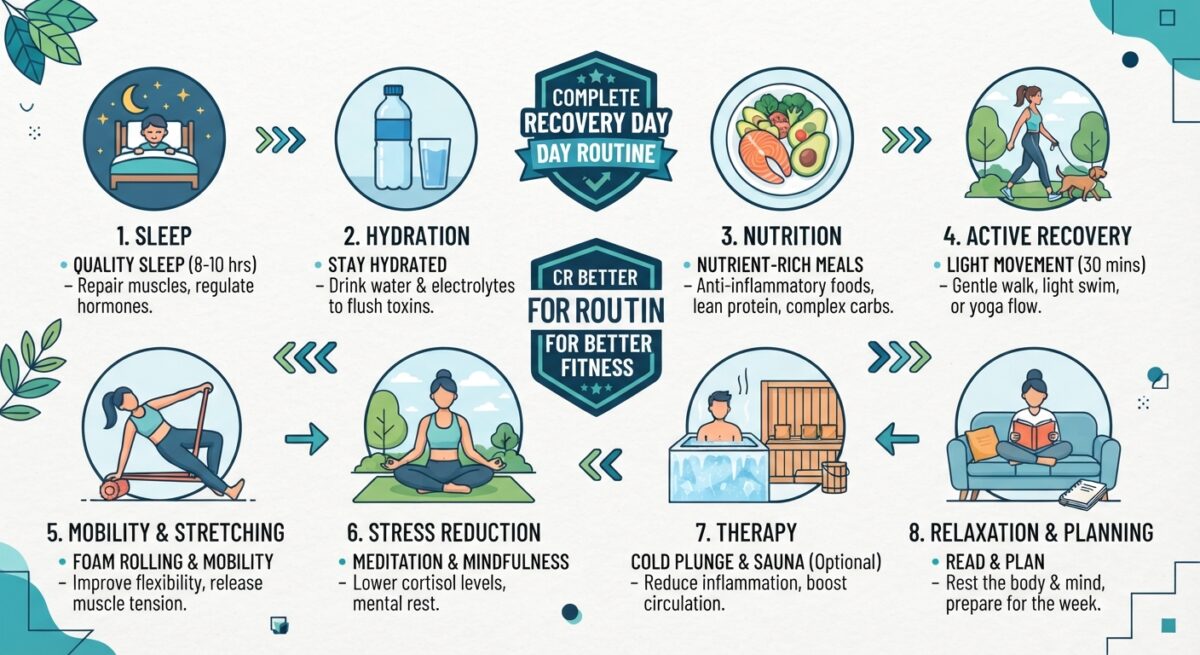
Complete Recovery Day Routine
A structured recovery day routine at home can fit comfortably into 45–60 minutes and should feel restorative rather than demanding. Based on how I structure recovery sessions, the aim is to use light movement, mobility, gentle stretching, foam rolling, and nervous system recovery without adding unnecessary muscle stress.
| Time | Recovery activity | What to do |
| 0–5 min | Light movement | Start with easy movement at a conversational pace. Choose gentle walking, a gentle yoga flow, easy cycling, or swimming at a leisurely pace. Avoid turning this into a 6-6-6 challenge. The goal is a small rise in heart rate and better blood flow without extra muscle stress. |
| 5–20 min | Mobility and stretching | Spend 10–15 minutes on mobility and stretching. For lower body recovery, use a hip flexor stretch, pigeon pose, hamstring stretch, quad stretch, and calf stretch against a wall. For upper body recovery, try a chest doorway stretch, cross-body shoulder stretch, tricep overhead stretch, cat-cow for the spine, and thread-the-needle for thoracic rotation. Use slow, controlled movements rather than forcing a stretch. |
| 20–35 min | Foam rolling / self-myofascial release | Use a foam roller, massage ball, or tennis ball on tight areas. Work through each muscle group slowly and pause when you find a tender spot, using gentle pressure. Target the IT band, outer thigh, quads, hamstrings, calves, glutes, upper back, the area between the shoulder blades, and lats. Do not roll directly over joints, the lower back, or neck. |
| 35–45 min | Breathing and nervous system recovery | Finish with 5 minutes of deliberate breathing. The goal is to help shift the sympathetic fight-or-flight response toward the parasympathetic rest-and-digest state. Try box breathing: inhale for 4 counts, hold for 4 counts, exhale for 4 counts, then hold for 4 counts. Repeat for 8–10 cycles. |
| 45–60 min | Easy finish and physical recovery | If you have extra time, keep the final part very easy. Focus on relaxed breathing, hydration, and letting your body settle. This calm finish can support physical recovery, healthy cortisol levels, a steadier heart rate, and better sleep quality. |
For dynamic stretching versus static stretching, keep the recovery session gentle and controlled; static stretching can be a practical choice after the light movement portion when it feels comfortable. The important part is not to turn a recovery day into another hard workout. You should finish feeling looser and calmer, not exhausted.
Active Recovery vs. Complete Rest: What the Research Says
After hard workouts, the goal is not simply to stop moving. The real goal is to recover well enough that your next session feels productive rather than exhausting. An active recovery day uses gentle movement to keep the body working at an easy intensity, while complete rest gives your body a chance to completely relax and focus on repair. Both approaches can support different fitness goals, and neither one is automatically better for every person or every rest day.
- Active recovery: This can include easy walking, gentle cycling, light yoga, mobility work, swimming, or other low-impact activities that keep blood flowing without adding much stress. The idea is to support muscle recovery, joint mobility, and general comfort while allowing tired muscles to recover after exercise. A practical target is often around 30–50% maximum effort, although the right level depends on your training background and how you feel that day.
- Complete rest: This means deliberately reducing physical demands and allowing your body to rest without planned training. You might sleep in, take a short nap, enjoy family time, read, or spend time sitting on the couch. Normal daily life is fine, but demanding work such as strenuous tasks, gardening, painting the house, or helping a friend move can turn a supposed rest day into another physically demanding day.
Research also gives some useful perspective. A 2019 meta-analysis published in Sports Medicine examined recovery strategies and found that the effects of different approaches can vary depending on the outcome being measured. For example, active methods may influence perceived soreness or physiological markers without necessarily producing dramatic improvements in every aspect of performance. Delayed-onset muscle soreness, commonly called DOMS, is one reason people often choose movement after difficult sessions, yet soreness itself does not provide a perfect measure of how completely the body has recovered.
How to Schedule Recovery Days
A good weekly plan should leave enough space for your body to recover instead of placing every training day back-to-back. In my experience, spreading hard sessions across the week makes a Complete Recovery Day Routine easier to follow and helps each workout feel more productive.
| Day | 3x per week | 4–5x per week | 6x per week |
| Monday | Training | Training | Training |
| Tuesday | Recovery day | Training | Lighter training + recovery elements |
| Wednesday | Training | Active recovery | Training |
| Thursday | Recovery day | Training | Lighter training + recovery elements |
| Friday | Training | Training | Training |
| Saturday | Leisure activity | Active recovery or leisure activity | Full recovery day |
| Sunday | Leisure activity/rest | Rest or recovery | Training or rest as needed |
Summary
Rest days help you become stronger while supporting improving performance and consistent exercise by giving your body time for muscle repair, energy restoration, and preparation for your next challenge. Whether you are a novice or seasoned athlete, recovery can include active recovery, mobility work, proper nutrition, and taking care of your feet, while regular rest helps manage fatigue and support overall performance. I find that low intensity workouts such as yoga and walking can keep you active while allowing you to recover. Taking enough breaks also gives you a better chance to reach your goals and build lasting fitness success.
FAQ’s
What does an ideal recovery day look like?
An ideal recovery day can include 20–30 minutes of light movement, such as walking, gentle yoga, or easy cycling, followed by 10–15 minutes of stretching for the muscles you trained. Add foam rolling or self-massage, then finish with 5 minutes of breathing exercises. A complete routine usually takes 45–60 minutes and should feel restorative, not exhausting.
Is active recovery better than complete rest?
For many healthy people, active recovery at around 30–50% effort can be useful. It may help reduce muscle soreness, support cardiovascular fitness, and improve nutrient delivery to damaged muscles. Complete rest may be more suitable when you are sick, injured, or dealing with overtraining, persistent fatigue, elevated resting heart rate, or disrupted sleep.
How many recovery days per week do I need?
Many people benefit from 2–3 recovery days per week, while beginners doing moderate exercise may need only 1–2 recovery days. Intense trainers doing heavy lifting or HIIT may need at least 2–3 recovery days. Rather than following a fixed schedule, watch your performance, strength, endurance, and motivation during consistent training, and listen to your body.
Does foam rolling actually help recovery?
Yes. Foam rolling may reduce delayed-onset muscle soreness (DOMS), improve range of motion, and increase blood flow to targeted muscles. A 2019 review in the Journal of Athletic Training reported benefits from 10–15 minutes of foam rolling after a post-workout session or on recovery days, including reduced soreness and better flexibility. For technique, Foam Rolling 101 can help, especially when using it alongside static stretching.
What are the signs that I need more recovery?
Common overtraining warning signs include muscle soreness lasting more than 72 hours, declining workout performance despite consistent effort, disrupted sleep, an elevated resting heart rate, irritability, mood changes, a higher frequency of colds or minor illnesses, and loss of motivation to exercise. If several signs appear together, consider adding extra recovery days and reducing training intensity for 1–2 weeks.