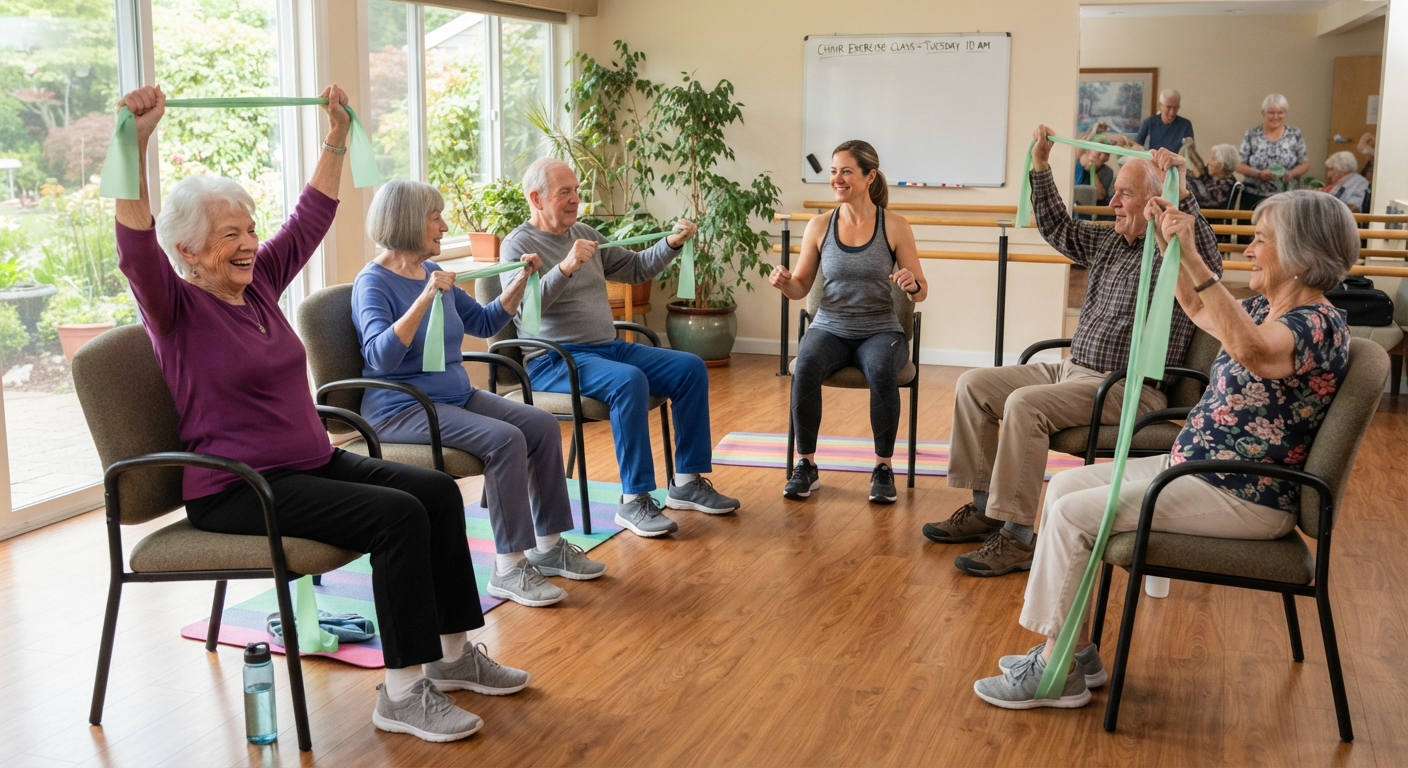
The Game Plan:
For older adults, seated exercise is one of the simplest ways to support healthy aging, even when physical changes, weaker muscles, or weaker bones make movement more difficult. During the golden years, limited mobility can sometimes make a person sedentary, especially when there is trouble getting up or being unable to move the muscles and joints freely and easily.
From my experience with fitness guidance, chair exercises are a practical starting point because seated options and standing options can make chair workouts more accessible for people of all ages. You do not need to push yourself into difficult forms of exercise to stay active and physically active; the good news is that you can keep moving in ways that suit your current ability.
| ⚠️ Fitness Disclaimer: This fitness disclaimer explains that the information in this article is for informational purposes only, not a substitute for professional medical advice, diagnosis, or treatment. Before starting an exercise program, consult a qualified healthcare professional, especially if you have an existing medical condition, an injury, or other health concerns. |
Exercise is an important part of a healthy lifestyle at any age, but it can become especially valuable as you grow older. Gentle movement can support mobility and independence, help manage certain conditions, reduce health risks, and boost mood. Exercising regularly may also help you become stronger and more flexible while supporting active aging. For seniors, staying active can also help with some health conditions linked with aging, including osteoporosis, heart disease, and deconditioning.
What Are the Benefits of Chair Workouts?
Chair workouts offer proven benefits without requiring the intensity of traditional forms of exercise. For older adults, this accessible option can make movement easier while still supporting health benefits. Based on practical senior-fitness guidance, I find that chair exercises are especially useful when standing or walking for long periods feels difficult.
1. Better circulation and heart health: Regular chair-based workouts can support greater circulation and better heart health. Even simple seated workouts can provide a useful form of physical activity for people who cannot comfortably follow more demanding exercise routines.
2. Stronger muscles: With age, muscle mass can decline, a condition known as sarcopenia. This can cause weaker muscles, impaired physical function, and reduced mobility. Chair exercises that combine stretching and strengthening exercises may help slow age-related muscle loss while improving upper body strength, lower body function, and overall strength.
3. Better balance and flexibility: Chair yoga, gentle stretches, and controlled movements can improve better balance and flexibility. Exercises such as sitting-to-standing, standing on one leg, and the chair-rising exercise can support balance and walking speed, particularly for people experiencing mobility problems.
4. Lower risk of falls: Better balance, strength, and flexibility can improve confidence during everyday movement and reduce the risk of falls. For seniors, this can make ordinary activities feel less intimidating and provide greater confidence when moving around independently.
5. Improved functional mobility: Functional mobility means having the capacity to move through various environments and perform critical movements, such as walking, bending, and standing. Because these movements are important for daily life, chair exercises can help maintain the ability to handle ADLs, meet basic needs, and remain independent.
6. Support for people with limited mobility: Seated workouts can be particularly helpful for nursing home residents and other people with limited mobility. Research involving seated exercise has shown improvements in physical function, making chair-based movement a practical way to stay active when conventional workouts are difficult.
7. Improved cognitive function: Physical activity does more than train the body; it also supports brain health. An active lifestyle may help keep memory sharp and slow cognitive decline as people age. Seated exercises can therefore support cognitive function, including among nursing home residents.
8. Better quality of life: The combination of physical and mental benefits may improve quality of life for older adults. A chair fitness program studied among older women found that after 14 weeks, participants showed better functional fitness, while also feeling happier and less stressed.
9. Greater emotional and social well-being: A complete chair-based fitness regimen can offer benefits beyond physical movement. Among inactive older adults, such programs have been associated with better physical function, cognitive function, emotional well-being, and social well-being, which can make regular activity feel more rewarding.
10. A practical way to stay active: When traditional exercise feels too demanding, chair workouts provide a safer-feeling and more manageable starting point. The ability to exercise while seated can help older adults continue moving, protect their mobility, and build a sustainable active lifestyle without giving up the benefits of regular exercise.
Seated Exercises for Seniors
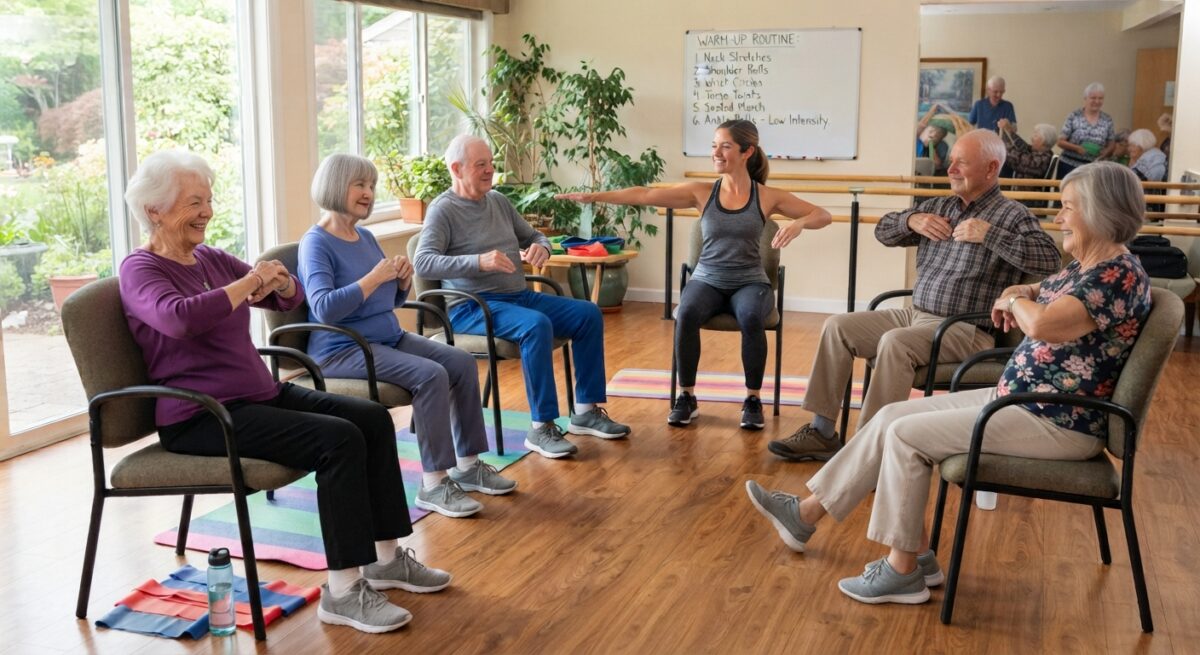
Warm up with low-intensity moves
Before any exercise, I recommend a gentle warm up using low-intensity moves. These simple movements can improve circulation, prepare the muscles, and make the body feel ready for the exercises ahead. Keep your movements controlled, and stop if you feel pain or unusual discomfort.
How to do it:
- Sit up with your back straight and your feet on the floor.
- Hold your arms forward with your palms facing down.
- Clench your fists, then open and close them three times.
- Roll your clenched fists in small circles.
- For ankle mobility, keep your feet steady and gently move your ankles as if preparing to walk.
- This movement can work as a gentle stretching and strengthening exercise.
- Sit tall with your palms resting on your thighs.
- Lift one leg straight out in front of you.
- Imagine your big toe is a pen and use it to trace the alphabet with large letters.
- Move your foot, rather than your whole leg, then repeat with the other leg.
Seated jumping jacks
Seated jumping jacks are a useful full-body cardio exercise when you want to raise your activity level without standing. This movement can support heart health, bone health, mobility, and coordination while keeping you seated.
How to do it:
- Sit near the front of your chair with your back straight.
- Keep your arms at your sides and your feet together.
- Draw your belly button toward your spine to engage your core.
- Move your arms overhead while stepping your feet apart to about shoulder-width apart.
- Return to the starting position by bringing your feet together and your arms down.
- Aim for 10 to 12 reps.
- Complete two to three sets, moving at a comfortable pace.
Chair core exercises
Chair core exercises help build a stronger base for everyday movement. A stable core includes the abdominal muscles, lower back, and glutes, and improving these areas may support balance and stability. I prefer controlled movements here because seniors can focus on good form without rushing.
How to do it:
- Sit with your back touching the back of the chair.
- Keep your feet on the floor and your legs comfortably apart.
- Keep your shoulders and upper body still.
- Gently engage your buttocks and abdominal muscles.
- Push your lower back gently into the chair while tucking your tailbone under you.
- Hold for a few seconds, then release.
- Repeat 10 times.
- This strengthening movement can support a strong foundation and may help protect against accidental falls.
Tummy Twists for Abs
Tummy Twists are a simple way to work your abs, obliques, and other abdominal muscles involved in trunk rotation. This movement can also encourage good posture when performed slowly. The difficulty is easy, with a suggested time of 3 minutes.
How to do it:
- Sit with your feet flat on the ground.
- Keep your elbows at your sides and your forearms forward at a ninety-degree angle.
- Keep your lower body still.
- Brace your core by gently drawing your belly button toward your spine.
- Rotate your upper torso to the left through a comfortable full range of motion.
- Return to the middle, then twist to the right.
- Perform 8-10 reps or ten repetitions on each side, for a total of twenty.
- Keep the movement controlled rather than forcing your body into a deep twist.
- Maintaining good alignment may be helpful if you have poor posture; back braces should not replace proper movement technique.
Captain’s Chair
This seated Captain’s Chair variation is a medium-level movement that focuses on the abs and core muscles, including the glutes. Use a sturdy chair and work within a comfortable position rather than trying to lift the legs too high.
How to do it:
- Sit up straight and grasp the edges of your seat.
- Keep both feet on the floor to begin.
- Slowly lift your feet and bring your knees toward your chest.
- Squeeze your abs at the top of the movement.
- Slowly lower your feet back to the floor.
- Do not move beyond a comfortable position.
- Even lifting your feet a few inches can be enough.
- Aim for 3 sets of 8-10 reps, with about 4 minutes of total time as a guide.
Captain’s Chair
This second Captain’s Chair is an advanced exercise that works both the arms and core. Because it requires more control, seniors should only try it if they can perform it safely and confidently. A steady chair and a controlled setup are especially important.
How to do it:
- Begin by standing tall, facing the chair.
- Bend over and place both hands on either side of the chair’s seat.
- Slowly shift your feet backward.
- Continue until your back is completely straight from your shoulder to your heel.
- You should feel gentle tension in your core muscles.
- Hold the position for up to 30 seconds.
- Rest, then repeat two to three times.
- Stop if you cannot maintain a straight back or controlled position.
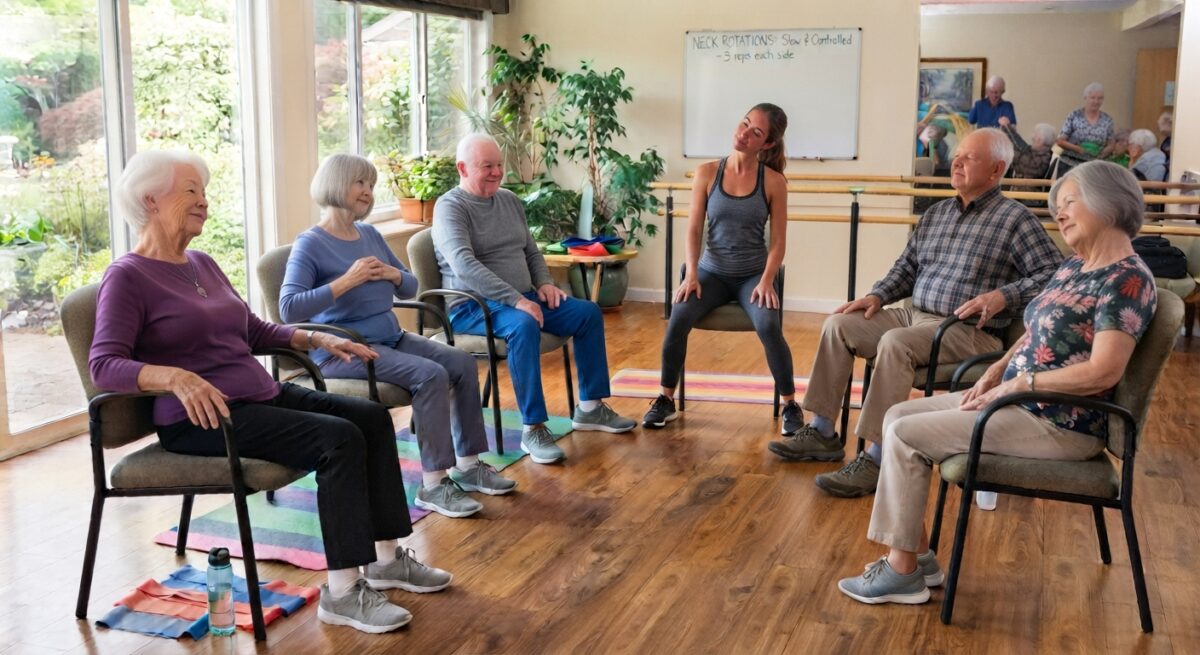
Neck rotation
Gentle neck rotation can help you practice comfortable head movement without forcing the neck. Keep your shoulders relaxed and make each movement slow.
How to do it:
- Sit on a chair with your feet hip-width apart.
- Keep your shoulders relaxed.
- Slowly turn your head to look over one shoulder.
- Return to the centre or middle.
- Look over the other shoulder, then return to the middle.
- Repeat 8 to 12 times in both directions.
- For an additional gentle movement, bring your ear toward your shoulder.
- Move your head down toward your chin and then across toward the other shoulder in a controlled half circle.
Shoulder rolls
Shoulder rolls are another easy seated movement for loosening the upper body. They can be added to a warm-up or used between other exercises when the shoulders feel stiff.
How to do it:
- Sit on a chair with your feet hip-width apart.
- Let your arms rest comfortably by your sides.
- Bring your shoulders upward toward your ears.
- Roll your shoulders backwards in a smooth circle motion.
- Perform 10 to 12 times.
- For the next step, place your hands on your shoulders.
- Move your elbows in a backward circle while keeping the movement comfortable.
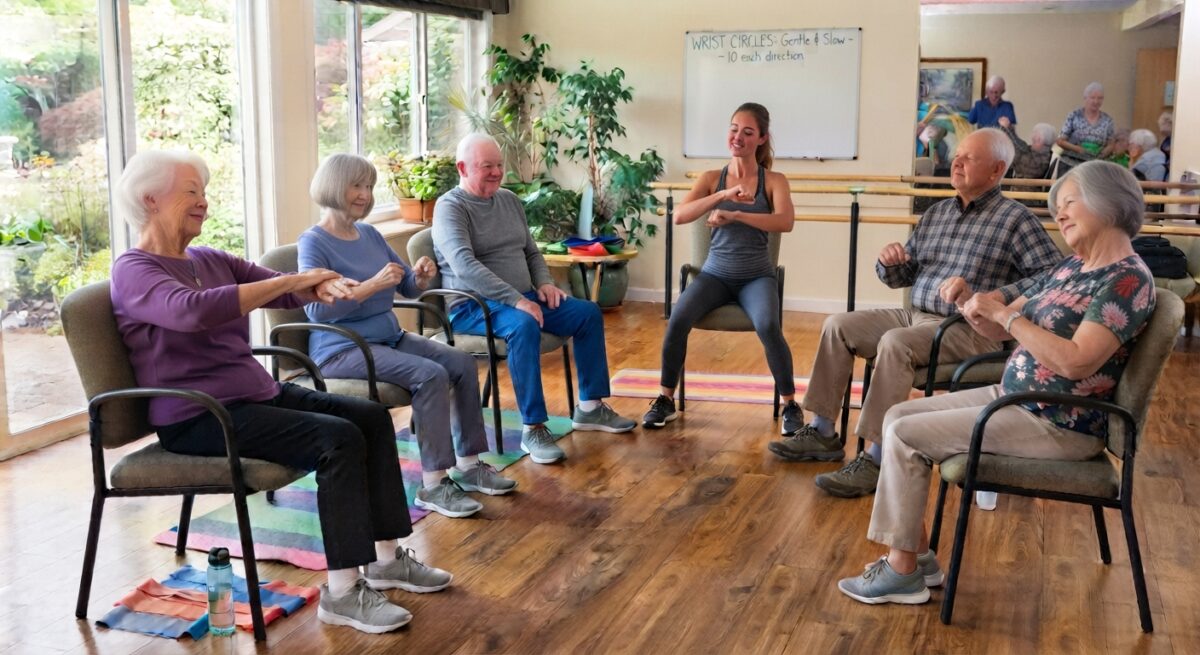
Wrist circles
Wrist circles are a gentle way to move the wrists and hands before or after other seated exercises. Keep your fists relaxed rather than gripping tightly.
How to do it:
- Sit on a chair with your feet hip-width apart.
- Hold your wrists and hands comfortably in front of you.
- Make gentle fists.
- Rotate both wrists in one direction 8 to 12 times.
- Repeat in the other direction for another 8 to 12 times.
- For the next step, clasp your hands together.
- Slowly rotate your hands together in controlled circles.
Summary
For seniors and older adults, chair exercises offer an accessible workout that can help people of different ages and fitness levels stay active, independent, and healthier. In my experience, seated exercises are especially useful when standing routines or traditional exercise routines feel difficult, since seated options and standing options can support balance, mobility, strength, cardiovascular fitness, and quality of life while being gentler on the joints and helping reduce pain.
They can be a real lifesaver for someone recovering from surgery or an injury, particularly when there is a high risk of injury with harder exercise. All you need is a sturdy chair, a safe space, and the desire to become stronger; while calling chair exercise the holy grail of fitness may sound bold, it can be a practical and valuable way for many seniors to keep moving safely.
FAQ’s
What is the best daily exercise routine for seniors?
A good daily exercise routine for seniors can include gentle cardio, functional strength, balance, and flexibility to help maintain independence and prevent falls.
What are five good chair exercises for seniors?
Five chair exercises include sit-to-stands, seated leg lifts, seated arm curls, torso twists, and seated calf raises. These seated chair exercises can be safe and easy to do at home.
Do chair exercises really work for seniors?
Yes, chair exercises can genuinely work for seniors by supporting safe functional strength, joint mobility, and daily stamina. These five effective chair exercises can make regular movement easier.
What are five exercises that seniors can do every day?
Seniors can do five simple low-impact exercises every day to support strength, balance, and daily mobility. Seated movements are a useful option when standing exercises feel difficult.